 San Diego July 4th Fireworks on San Diego Bay – Big Bay Boom
Countdown to July 4th, 2027
TOURISM: Over 26 Years, Big Bay Boom Has Grown to $100M Economic Impact
BY MADISON GEERING, San Diego Business Journal
Read the original article on the San Diego Business Journal Website here
SAN DIEGO – Twenty-six years ago, Sandy Purdon ignited the first annual Big Bay Boom as a personal project. Today, it’s the largest Independence Day fireworks show on the West Coast.
“I always get a tear in my eye when I watch the show, even though I know what’s coming,” Purdon said. “It’s a pretty good country we live in. We’re very fortunate, and this is the one day a year we can celebrate that.”
This year, the Big Bay Boom will recognize America’s 250th anniversary. It will also mark Purdon’s last season at the helm of the event.
Purdon has been general partner at Shelter Cove Marina for over 30 years. When he was building his house in Point Loma in 2000, he realized there was no fireworks show on the “natural amphitheater” of the North San Diego Bay.
While Purdon hoped to view a show from the comfort of his new home, he also saw the opportunity to create an economic boost for the region during a week when the San Diego Convention Center (SDCC) was usually closed.
With the support of former Sheraton Harbor Island General Manager Joe Terzi, Purdon secured the Port of San Diego as the event’s title sponsor.
The first show’s budget was about $40,000. Today, it’s $1 million, half of which is exclusively put toward fireworks.
The economic impact of the 2024 Big Bay Boom totaled $100 million from non-local attendees, a 34% increase from the 2022 Big Bay Boom.
This year, Fleet Week San Diego is the event’s nonprofit partner. Purdon, who served in the U.S. Marine Corps for 9 years, said that recognizing military servicemembers and veterans has always been important for the event.
The 2026 show will be no different, especially considering the country’s milestone.
“Everybody tells me after the latest show, ‘That was the best show ever,’” Purdon said. “I’m sure that’s true, because they’re all great and it’s fresh in your mind, but I think you’ll walk away from this one feeling that it’s very special.”
Commemorating America’s Birthday
The Big Bay Boom draws about 400,000 live viewers. That’s the equivalent of 10 sold-out Padres games.
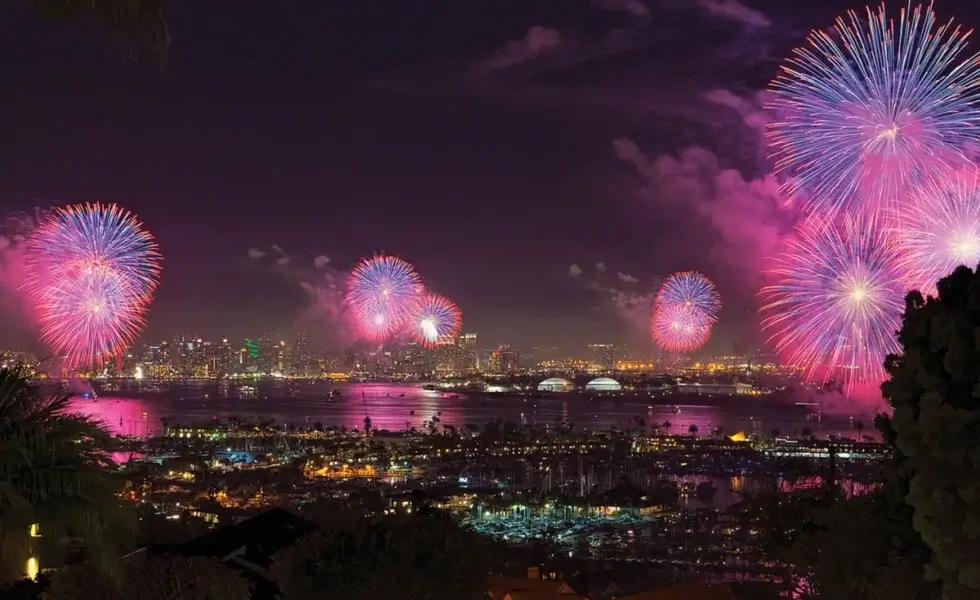
Locals and tourists alike view the show from many vantage points around the bay, including Shelter Island, Harbor Island, North Embarcadero and Coronado Ferry Landing.
Some viewers are boaters who take a front-row seat on the water while being mindful of safety guidelines. Other viewers, like Purdon, host viewing parties in their own residences.
“We watch it from our house. It’s such a good view that Fox 5 San Diego puts a camera in our master bedroom overlooking the bay, because it sees all four barges,” Purdon said. “We have a great time. We’ve entertained friends and family for years from that location.”
This year’s Big Bay Boom is scheduled for 9:15 p.m. with accompanying musical simulcast on 91.1 FM. It will also be broadcast live at 9:15 p.m. on FOX 5 San Diego and streaming on the FOX 5 / KUSI NOW app.
The radio program will include a special introduction honoring America 250.
“The television show has just exploded exponentially. We’re the largest show in the West,” Purdon said. “The Macy’s 4th of July Fireworks on the Hudson River is probably the granddaddy of them all, but we’re the granddaddy on the West Coast.”
The Big Bay Boom actually uses the same pyrotechnics supplier as the Macy’s show — a California-based company called Pyro Spectaculars.
Planning for each Big Bay Boom starts in September of the year before. Purdon said that it takes about four to five days to load the barges for the event. An extensive team of divers and cleanup crew helps collect any debris from the event on July 5.
“You’d be amazed at how many people are involved,” Purdon said.
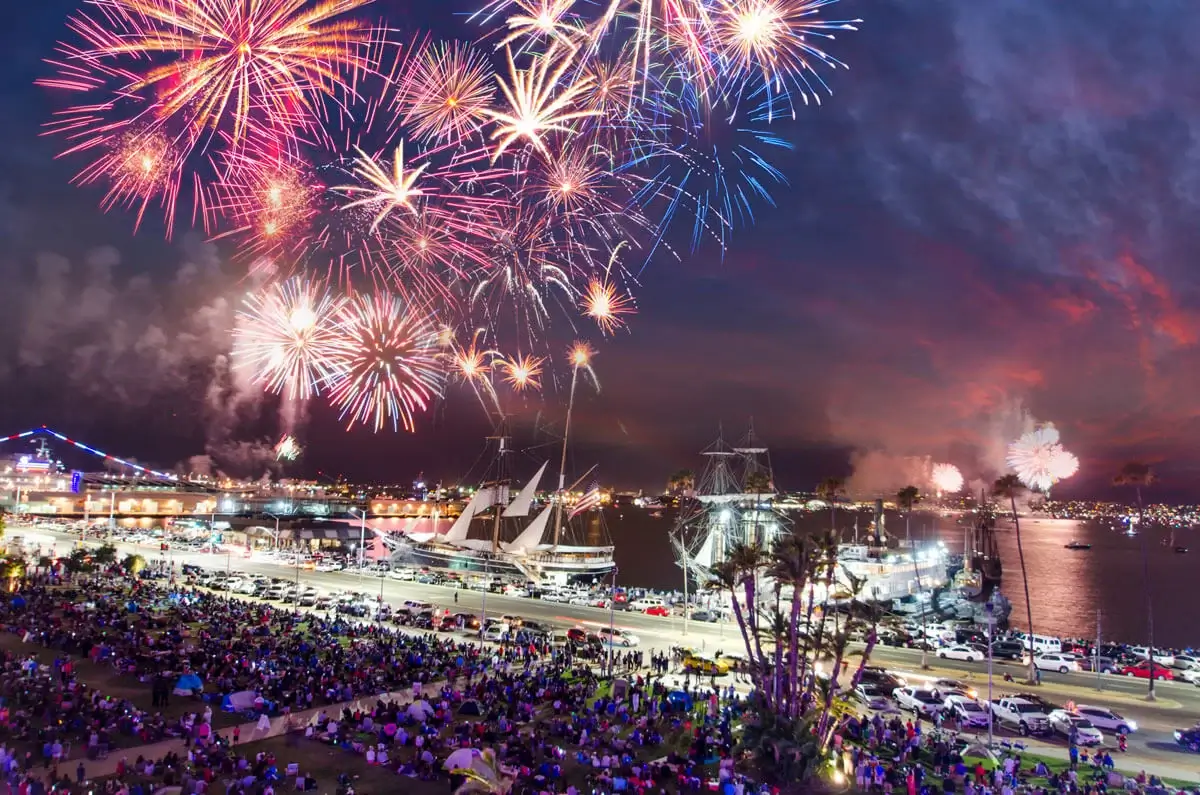
The Big Bay Boom draws about 400,000 live viewers, the equivalent of 10 sold-out Padres games. Photo courtesy of Big Bay Boom
Future of West Coast’s Biggest Firework Show
The future of the Big Bay Boom is in flux. In early 2025, the California Coastal Commission gave the Port and event organizers notice that they will need to rethink the use of fireworks during the Big Bay Boon to protect the bay and nearby wildlife.
The Big Bay Boom does its best to clean up after itself and reduce environmental impact, Purdon said, pointing to its team of divers as an example.
The Commission said the scale of the show needs to be downsized and may need to be transitioned to a drone-only aerial light show in future years.
The notice also required the Port to conduct a study on the possibility of replacing fireworks with drones or using drones to complement a downsized fireworks show, starting July 4, 2027.
“We’re not sure what’s going to happen going forward,” Purdon said. “I think we have a pretty good argument that, one day a year, fireworks on the bay are good.”
Purdon said that some of his concerns about drones include price, dangers if a drone were to lose connection and fall from the sky and coordinating logistics with nearby airports. He added that there are still a lot of unanswered questions being investigated about what a transition to drones might look like.
Next year, leadership of the Big Bay Boom will transition out of Purdon’s hands as he retires from the event.
He recalled the “Big Bay Bust” fiasco from 2012 — when all the fireworks went off at once — as a favorite memory of his. The show gained international attention for the debacle and was “put on the map.”
“I’ll keep watching it, but [the Port has] some very talented people in [its] Parks and Recreation department that will pick up the mantle,” he said. “I’m sure it’ll get better and better every year.”